

Technical insight
Starter Battery Selection for Agricultural Machinery and Generators
Select an agricultural machinery or generator starter battery by crank demand, standby time, vibration, charging, temperature and service access.
An agricultural machinery starter battery or generator starter battery must be selected around the specific start event, the time between starts, and the charge source available between cranks. A tractor battery that starts once per shift, endures field vibration, and recharges from an engine alternator serves a different duty than a generator battery that sits on a maintenance charger for months before a critical power outage.
NaVolt’s sodium-ion battery range provides model options for engineering review in both applications when voltage, CCA, capacity, dimensions, terminals, and charging requirements are compared with the equipment’s OEM starting-system specification. This guide shows how to build a practical shortlist and prepare the information NaVolt needs for a productive application review.
Generator starting begins with the OEM specification, not the kVA rating
A generator’s battery requirement is defined by its engine starter motor, not by the generator’s kilovolt-ampere (kVA) output. Two generators with the same kVA may use different engine families, starter sizes, or cold-cranking requirements. Battery selection for a standby generator must therefore start with the engine starter specification.
For generator OEM teams and integrators, the steps are:
- Record the generator model, engine make, model, and displacement.
- Record the starter motor part number, voltage, rated current, and pinion type.
- Identify the required cranking speed and minimum voltage from the engine manufacturer.
- Note the lowest ambient starting temperature the application must support.
- Review the original-equipment battery specification—chemistry, voltage, capacity, CCA, and the test standard the CCA value references.
- Check whether pre-heaters, controls, fuel systems, or other loads are energised before the starter engages.
The OEM application manual, such as Cummins Power Generation’s T030 manual, provides the system-voltage, charger, cable-sizing, and voltage-drop context for generator starting-system design. Generac’s owner manuals for standby generator models similarly define the battery specifications and integrated charging behaviour that are specific to each generator model. These documents, not a general kVA-to-CCA conversion, are the correct starting point.
Mobile machinery and standby generators need different readiness controls
| Factor | Agricultural or construction machinery | Standby generator set |
|---|---|---|
| Use pattern | Seasonal or shift-based field work | Long standby followed by critical start |
| Mechanical environment | Vibration, shock, dust, washdown | Fixed enclosure, heat and charger exposure |
| Charging | Engine alternator with variable run time | Float/maintenance charger plus alternator |
| Review priority | Mounting, charge recovery and cable integrity | Charger integration, standby condition and scheduled readiness checks |
| Service access | Remote field or dealer network | Scheduled site maintenance |
This table should shape the validation plan. A battery proven in a passenger car still needs application-specific work before it is approved for machinery or generator duty. The sample-validation checklist at the end of this guide captures the key stages.
Define the starting requirement
Collect the engine displacement, fuel type, oil grade, starter rating, minimum temperature and required crank speed. If the original battery has a CCA rating, record the test standard as well as the number.
SAE J537 is one automotive storage-battery test reference. An equipment maker may use another internal or market standard. Compare samples under the same method.
Also record the start sequence. Some diesel equipment powers pre-heaters, control modules, fuel systems or hydraulic devices before the starter engages. Those loads reduce the energy available for cranking.
How to shortlist an agricultural machinery starter battery
Current NaVolt B, D and H models are 12 V products. LR-N100 is a separate 24 V platform. Confirm whether the machine uses one 12 V battery, two batteries in an engineered series arrangement or a dedicated 24 V pack.
The following table presents NaVolt models that are useful starting points for machinery and generator project review. Each model’s voltage, CCA, capacity, dimensions, weight, terminals, and temperature range are controlled product specifications. They are shortlist inputs—not application guarantees.
| Model | Voltage | Capacity | CCA | Max dimensions (W×D×H) | Weight | Review position |
|---|---|---|---|---|---|---|
| B24-12V-660 | 12 V | 30 Ah ±5% | 660 A | 238 × 130 × 222 mm | 5.45 ±0.5 kg | Compact equipment case review |
| D23-12V-850 | 12 V | 40 Ah ±5% | 850 A | 231 × 175 × 222 mm | 6.52 ±0.5 kg | Mid-size engine and D23 case review |
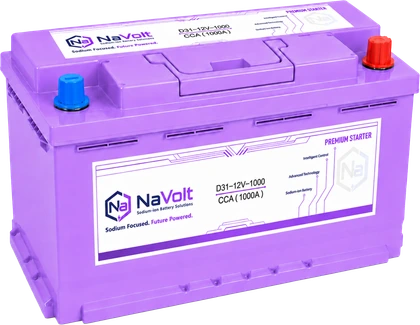
| D31-12V-1000 | 12 V | 50 Ah ±5% | 1,000 A | 306 × 173 × 222 mm | 7.85 ±0.5 kg | Larger machinery and D31 case review |
| H7-12V-750 | 12 V | 60 Ah ±5% | 1,200 A | 315 × 175 × 190 mm | 8.90 ±0.5 kg | Higher-cranking 12 V project review |
| H8-12V-840 | 12 V | 70 Ah ±5% | 1,400 A | 354 × 175 × 190 mm | 10.15 ±0.5 kg | High-demand generator or machine review |
| H9-12V-900 | 12 V | 80 Ah ±5% | 1,600 A | 410 × 175 × 190 mm | 11.40 ±0.5 kg | Largest 12 V H-series cranking class |
| LR-N100-24V | 24 V | 100 Ah | 2,000 A | 524 × 365 × 233 mm | 30 ±1 kg | Dedicated 24 V truck/special-vehicle review |
The current 12 V NaVolt models specify a 15.8 V charge voltage and M6 bolt-type terminals. B19 lists a discharge range of -40°C to 60°C; the other ten current 12 V models list -45°C to 60°C. The separate 24 V LR-N100 approved sheet lists an operating range of -40°C to 70°C. These values are model fields, not automatic application approvals. The tray, hold-down, terminal design, cable cross-section, enclosure, and charging system complete the engineering review.
Battery Council International group-size guidance is useful for dimension and terminal-location reference, but the actual equipment installation must be inspected.
Vibration and connection design
Field machinery can expose batteries to repeated shock and vibration. Confirm that the enclosure, cells, BMS and connections have been validated for the target profile. Do not infer a vibration rating from an automotive application description.
NaVolt’s current 12 V specifications list M6 bolt-type terminals. The installation drawing should define lug size, conductor cross-section, torque, locking, strain relief and insulation. Reinspect the connection after the pilot period.
Connection points to validate during the pilot include:
- cable lugs working loose;
- ground straps corroding or cracking;
- battery movement because the clamp does not engage;
- dust or moisture contamination around connections;
- cable tension caused by an approximate case match.
Charging review completes the shortlist
Current NaVolt 12 V specifications list a 15.8 V charge voltage. The machine’s alternator or the generator-set’s maintenance charger must be reviewed against the battery’s approved charging requirement.
For mobile equipment
Measure charge voltage and current at idle and working speed, with lights, fans, pumps, and other loads active. Short seasonal jobs may not restore the battery after repeated starts. NaVolt’s 12 V specifications state a charge temperature range of -20°C to 45°C. Confirm the operating environment falls within this range.
For standby generators
Review the maintenance charger’s chemistry setting, voltage accuracy, temperature compensation, current limit, and fault alarm. A charger designed to hold a lead-acid battery at a long-term float condition should not be assumed suitable for a sodium-ion pack without approval.
Generac’s support documentation on standby-generator battery charging describes how the generator’s integrated charging system maintains the battery during standby periods and how the charger behaviour is tied to the generator model’s control logic. This illustrates why battery charging for a standby generator must be evaluated at the generator-system level, not assumed from a general battery-charger specification.
Cable selection and voltage drop between the charger, battery, and starter are also application-specific inputs. The Cummins T030 manual provides voltage-drop calculation guidance for generator starting circuits. Undersized cables or excessive distance can prevent the battery from receiving its required charge voltage or delivering full cranking power.
Seasonal storage needs a written procedure
The current 12 V specifications state storage from 0°C to 45°C and instruct long-term storage around a partial state of charge with periodic maintenance. The source documents also describe a three-month inspection or recharge interval.
Turn that into a site procedure:
- disconnect or quantify parasitic loads;
- record state of charge before storage;
- store within the approved temperature and humidity limits;
- inspect terminals, case and mounting on schedule;
- use only the approved charger and procedure;
- run a functional start test before the operating season.
Do not treat a broad company statement about 0 V storage as permission to leave every installed battery deeply discharged. Recovery conditions and system configuration need model-specific approval.
Generator readiness test
A standby generator programme should include more than its scheduled engine exercise. Record:
- battery voltage before the test;
- charger voltage and alarm status;
- crank current, duration and minimum voltage;
- time to recharge after the start;
- enclosure and battery temperature;
- terminal voltage drop;
- reason for any failed or delayed start.
Load-bank testing of the generator and battery testing answer different questions. Both may be needed in a critical-power maintenance plan.
RFQ input checklist for generator OEM teams and equipment buyers
Include the following information with an RFQ to enable a productive engineering review:
| Category | Required detail |
|---|---|
| Generator/equipment model | Make, model, year, engine make and model, displacement |
| Electrical system | System voltage, starter part number and rated current, required cranking speed |
| Original battery | Chemistry, model, voltage, Ah, CCA and the test standard referenced |
| Installation | Tray dimensions, hold-down type, terminal orientation, lug type, cable length and cross-section, enclosure photographs |
| Climate | Minimum ambient temperature, enclosure temperature if applicable, humidity |
| Charging source | Alternator (mobile) or maintenance charger model, voltage, current, temperature compensation, chemistry mode |
| Duty profile | Starts per day/shift, typical run time between starts, seasonal or continuous operation, maximum standby period |
| Validation | Number of samples, desired test standard, pass criteria, timeline |
| Commercial | Annual volume, target markets, service footprint |
Frequently asked questions
Can a car battery be used in a tractor or generator?
Only after the engine, case, connection, vibration, temperature and charging requirements are checked against the equipment’s OEM specification. A passenger-car application label does not prove suitability for field machinery or standby service.
Is CCA more important than Ah for machinery starting?
Both answer different questions. CCA addresses short cold-cranking output under a defined method; Ah helps describe stored charge for pre-start and engine-off loads. The duty profile decides the balance. For a standby generator, the charger’s ability to maintain the battery during long idle periods is as important as the cranking specification.
How do I select a generator starter battery if I know the kVA rating but not the starter specification?
Start with the generator OEM’s engine and starter specification, not the kVA. The model’s application manual or original-equipment battery part number provides the correct starting-system reference. If the original battery label is unavailable, request the engine model and starter part number from the generator manufacturer.
Can an existing lead-acid maintenance charger be retained with a sodium-ion battery?
Not automatically. Confirm voltage, control method, temperature compensation, and fault behaviour against the sodium-ion battery’s approved charge procedure. A charger holding a lead-acid battery at long-term float voltage may not match the 15.8 V charge profile of current NaVolt 12 V specifications.
What is the minimum information a generator OEM should send with a battery RFQ?
Include the generator model, engine make and model, starter part number, system voltage, original battery specification, tray dimensions and terminal type, minimum startup temperature, charger model and settings, standby period, and annual volume. This enables a targeted model shortlist.
How often should a standby generator battery be checked?
Use the interval and exercise procedure in the generator OEM manual and the site’s maintenance programme. At each scheduled readiness check, record voltage before the start, crank current and minimum voltage, recharge behaviour, terminal condition, and charger status. Generator load testing and starter-battery testing answer different questions, so the maintenance plan should define both where the application requires them.
Conclusion
Agricultural machinery and generator starter-battery selection begins with the engine’s starter specification but succeeds through installation, charging, and maintenance. Define the field or standby duty, identify the correct OEM starting-system inputs, and validate a current NaVolt battery sample under representative conditions with the appropriate engineering review.
Review the NaVolt starter battery range or submit a machinery or generator project RFQ with the checklist above for a targeted model shortlist.
For product downloads, see the NaVolt documentation page.
Sources
- SAE International, J537_202309: Storage Batteries.
- Cummins Power Generation, T030 Application Manual — generator starting-system voltage, charger, cable, and voltage-drop context.
- Generac Power Systems, Home Standby Generator Owner’s Manual (G-8-13kVA 50Hz CE).
- Generac Support, How Is My Home Standby Generator Battery Charged.
- Battery Council International, BCI Group Sizes.
- NaVolt 12 V Sodium-Ion Battery Technical Specifications, current revisions.
- NaVolt LR-N100 Approved Product Sheet, current revision.