

Technical insight
CCA and Cold-Start Testing for Starter Batteries
Learn how to compare CCA and cold-start tests across starter batteries, including conditioning temperature, voltage limits, charge state and pass criteria.
An 850 A CCA label is incomplete without the standard, conditioning temperature, state of charge, load duration and minimum-voltage criterion behind it. Change any of those conditions and the number may no longer be comparable.
For distributors, fleets and OEM validation teams, the practical rule is simple: use controlled bench testing to compare batteries, then use the target engine and vehicle to decide whether the result is useful.
Key takeaways
- CCA is a test result under defined conditions, not a universal measure of battery quality.
- Record the standard and revision used for every quoted CCA value.
- Separate a short cranking test from continuous discharge-current limits.
- Separate discharge-temperature capability from charging permission at low temperature.
- Define voltage, time and recovery criteria before samples arrive.
- Use the final H8 rating of
1,400 A CCAand H9 rating of1,600 A CCA.
Contents
- What CCA means
- Why CCA numbers may not be comparable
- How to write a cold-start test plan
- How to read NaVolt specifications
- How to validate in a vehicle
- Common testing mistakes
What CCA means
Cold Cranking Amps describes a battery’s ability to deliver high current at low temperature while maintaining the voltage required by the applicable test method. SAE J537 provides procedures for automotive storage-battery testing.
The exact acceptance sequence belongs to the selected standard and laboratory procedure. An RFQ or test report should therefore state more than “CCA = 850 A.” It should identify the standard, revision, conditioning, load, duration, voltage criteria and instrumentation.
Why CCA numbers may not be comparable
Different standards
SAE, EN and other market methods can define the test differently. Do not compare values from two standards as though they were produced by one procedure.
Different temperatures
A test at one cold temperature cannot be directly compared with a test at another temperature. Record battery-core or chamber conditioning and the allowed stabilization time.
Different state of charge
The same battery can produce different results depending on charge method, rest time and state of charge before testing. The preconditioning procedure must be controlled.
Different voltage and time criteria
A peak-current statement, a short pulse test and a full CCA procedure answer different questions. A fast pulse response may matter to system design, but it cannot be relabelled as CCA unless the standard and pass criteria match.
Prototype versus production status
Record sample build, firmware/BMS version, cell lot and production revision. A final catalogue rating still needs to be tied to the production revision tested.
How to write a cold-start test plan
Step 1: Define the decision
State what the result will approve: a catalogue rating, an original-battery match, a specific engine, a fleet route or a chemistry comparison. Without that decision, laboratories can produce accurate data that still does not answer the buyer’s question.
Step 2: Select the standard
Name the test standard and revision. If the buyer requires an internal method, attach the full procedure and explain how it relates to a recognized standard.
Step 3: Identify samples
Record:
- Manufacturer and model
- Nominal voltage and capacity
- Claimed CCA and status
- Serial number or lot
- Cell and BMS revision
- Date of manufacture
- Initial inspection result
Step 4: Control preconditioning
Define charge voltage/current, termination, rest period, chamber temperature, stabilization time and measurement tolerance. Apply the same procedure to every comparison sample unless the test objective explicitly requires otherwise.
Step 5: Define load and pass criteria
Specify current, duration, minimum voltage, recovery voltage, allowed temperature rise and any interruption rules. Calibrate the load bank, voltage channels, current sensor and temperature sensors.
Step 6: Keep the trace, not only the verdict
Keep time-series current, voltage and temperature data instead of only a pass/fail line. The trace can expose voltage sag, BMS intervention, connection resistance or one weak sample. A photograph of a display at the end of the test cannot do that.
Step 7: Repeat and review variation
One successful sample does not define production performance. Set the sample quantity, repeat count and acceptance rule before the first unit enters the chamber.
CCA is not continuous current
The H5-12V-500 provides a useful example:
| Field | Current H5 value | What it means |
|---|---|---|
| Nominal voltage | 12 V | Vehicle/system class |
| Capacity | 40 Ah ±5% | Stored-charge specification under stated conditions |
| CCA | 850 A | Cold-cranking rating under the applicable method |
| Maximum continuous discharge | ≤40 A | Continuous operating limit in the product specification |
| Discharge cut-off voltage | 6 V | Product electrical limit |
| Charge voltage | 15.8 V | Confirmed charge voltage; use the approved charging procedure |
| Maximum continuous charge | ≤20 A | Continuous charge limit |
The 850 A CCA figure does not authorize continuous discharge at 850 A. Conversely, the 40 A continuous limit is not evidence that the battery can provide only 40 A during a short crank.
How to read NaVolt specifications
Use current model values
The current H-series specifications list:
| Model | Capacity | CCA | CCA status |
|---|---|---|---|
| H4-12V-400 | 30 Ah ±5% | 660 A | Current specification |
| H5-12V-500 | 40 Ah ±5% | 850 A | Current specification |
| H6-12V-600 | 50 Ah ±5% | 1,000 A | Current specification |
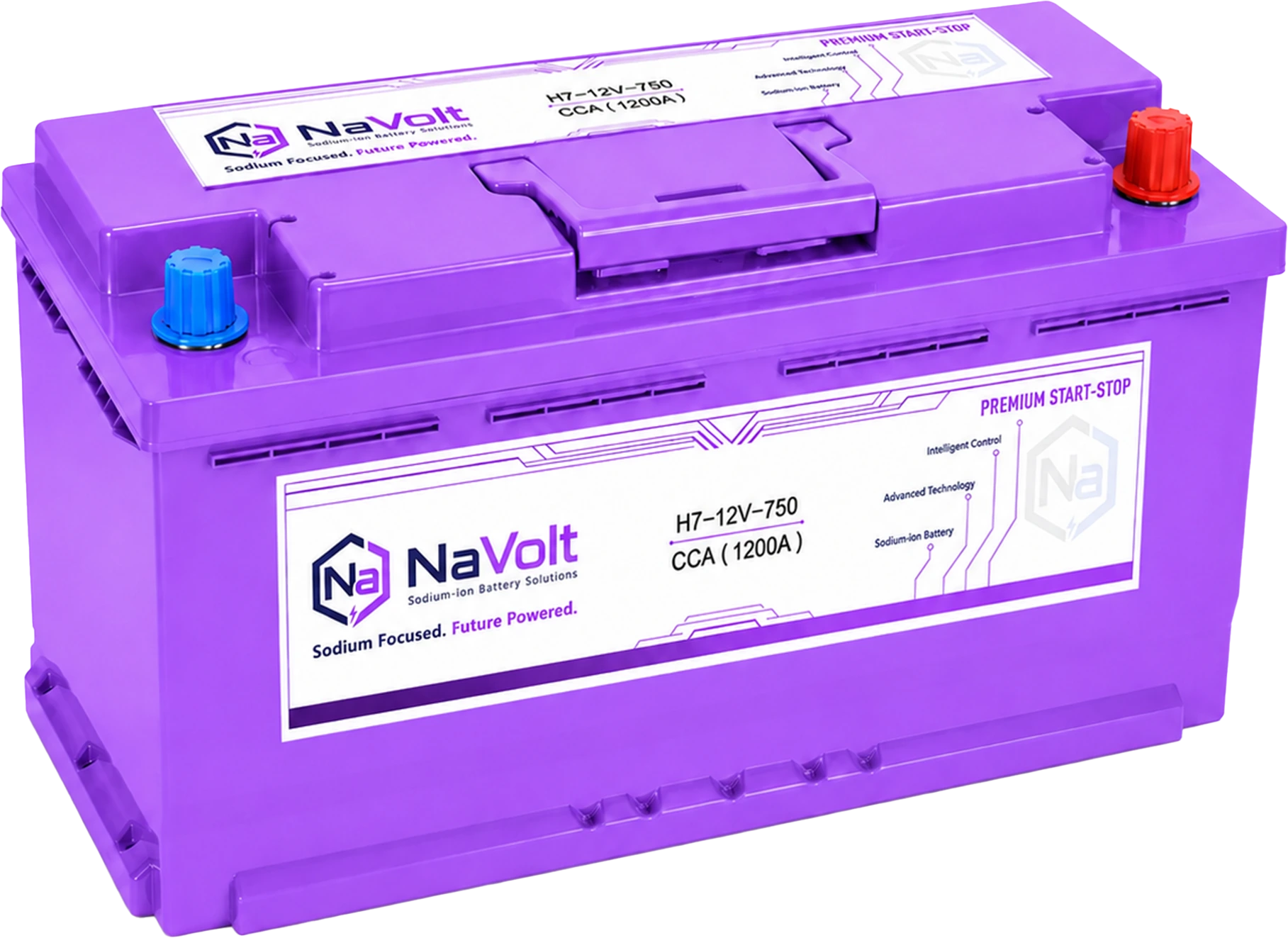
| H7-12V-750 | 60 Ah ±5% | 1,200 A | Current specification |
| H8-12V-840 | 70 Ah ±5% | 1,400 A | Final specification |
| H9-12V-900 | 80 Ah ±5% | 1,600 A | Final specification |
The model suffixes for H4-H9 are not the CCA values. Keep model and CCA in separate database fields.
Separate model temperature fields
The current H5 specification lists charging from -20°C to 45°C and discharging from -45°C to 60°C. A broader range shown for another product or marketing scope must not replace these model-specific fields.
Qualify platform cycle claims
NaVolt product material states more than 100,000 start-stop operations and more than 3,000 cycles for the platform. Those figures are not a warranty model by themselves. Ask for the applicable product, test method, depth of discharge, temperature and end-of-life criterion before using them in a service-life calculation.
How to validate in a vehicle
Bench CCA data makes samples comparable; it does not reproduce every vehicle condition. Add a vehicle plan that covers:
- Cold soak and first start
- Repeated automatic stop/start events
- Hot restart after engine-bay heat soak
- Accessory loads while the engine is off
- Alternator and smart-charge behavior
- Battery sensor and registration/coding
- Sleep current and long parking
- Diagnostic faults and recovery
- Terminal voltage drop during crank
Log ambient and battery temperatures, engine speed, crank duration, minimum voltage, charge current and diagnostic status. Use the same vehicle and procedure across samples. “The engine started” is an observation, not a complete validation record.
Common testing mistakes
- Comparing SAE and EN CCA values without identifying the method
- Using a handheld estimate as the only acceptance result
- Testing samples at different states of charge
- Ignoring cable and terminal resistance
- Calling a short peak-current pulse a CCA test
- Publishing prototype or provisional results as final production data
- Treating discharge temperature as permission to charge at the same temperature
- Using one successful vehicle start as proof of fleet life
Test request template
Include this information in the RFQ or laboratory request:
- Target model and specification revision
- Test standard and revision
- Sample quantity and lot requirements
- Charge/preconditioning method
- Conditioning temperature and duration
- Load current and time
- Minimum voltage and recovery criteria
- Instrument accuracy and sampling rate
- Repeat count and pass/fail rule
- Required raw data, photos and report approvals
Frequently asked questions
Does higher CCA always mean a better starter battery?
No. Higher CCA can provide more cranking margin, but the battery must also match voltage, charge behavior, dimensions, terminals, temperature, BMS behavior and vehicle duty. Compare CCA only under the same standard and test conditions.
Is a cold-start claim the same as CCA?
Not necessarily. “Cold start” may describe a vehicle demonstration or an internal pulse test. CCA is meaningful only when tied to a defined standard and acceptance method.
Can I use a battery’s discharge-temperature range as its cold-start rating?
No. A discharge range identifies an operating boundary, while cold-start performance depends on the test current, temperature, voltage limit, duration, state of charge and sample condition.
What are the final H8 and H9 CCA ratings?
The final H8 specification lists 1,400 A CCA, while the final H9 specification lists 1,600 A CCA. H9 weight is confirmed at 11.40 ±0.5 kg. Test reports should still identify the applicable standard, conditioning and production revision.
Conclusion
The most useful CCA report is the one another engineer can repeat. It identifies the sample, standard, preconditioning, chamber condition, load, voltage trace and acceptance rule. Once that record is sound, the vehicle trial can focus on what the bench cannot reproduce: the engine, cables, software and real duty cycle.
Next step: send NaVolt your target CCA standard and vehicle data or review the sodium-ion start-stop battery range.
Sources
- SAE International, J537_202309: Storage Batteries.
- NaVolt 12 V Sodium-Ion Battery Technical Specifications, current revisions.
- NaVolt start-stop product material, current controlled version.