

Technical insight
Cold Weather Car Battery Selection: A Winter Buyer Checklist
Use this cold weather car battery selection checklist to compare CCA, charge limits, case fit, vehicle loads and winter validation before ordering.
Cold weather car battery selection starts with more than a high CCA number. Buyers must define the lowest battery temperature, engine requirement, parking duration, charge opportunity, case and terminal fit, and the electrical loads that remain active before and after starting.
The useful winter battery is the one that can be charged, installed and monitored correctly as well as cranked in the cold. A discharge-temperature claim or one successful demonstration cannot answer all five questions.
The five winter questions to answer first
- What is the lowest expected battery temperature—not only the weather forecast?
- What CCA standard and minimum voltage does the engine programme require?
- How long is the vehicle parked between charge opportunities?
- Which loads remain active during parking and idle stop?
- Can the vehicle charging system operate within the battery’s approved limits?
These questions separate a real specification from a “cold climate” label.
CCA is useful only with its test conditions
Cold Cranking Amps describes high-current output under a specified low-temperature procedure. SAE J537 is one recognized reference for automotive storage-battery testing. Other markets may use different standards and acceptance criteria.
When comparing quotations, record:
- test standard and revision;
- conditioning temperature and duration;
- state of charge and pre-charge method;
- test current and duration;
- minimum and recovery voltage;
- sample count and production revision.
Do not place SAE, EN and internal pulse-test values into one ranking column without identifying the method. A peak-current demonstration is not automatically a CCA result.
Separate discharge temperature from charging temperature
A battery may be able to deliver power at a temperature where it should not accept normal charge current. This distinction is especially important when a vehicle starts after an overnight cold soak and the alternator immediately begins charging.
Current NaVolt H-series specifications list:
- charge temperature:
-20°C to 45°C; - low-temperature charge note: use
0.1Cfrom0°C to 5°C; - discharge temperature:
-45°C to 60°C; - charge voltage:
15.8 V.
These values define product operating boundaries. Vehicle integration still needs an actual voltage/current profile, including smart-alternator states and any low-temperature charge control.
Match winter risk to the model range
| Model | Capacity | CCA | Maximum dimensions (W × D × H) | Typical review position |
|---|---|---|---|---|
| H4-12V-400 | 30 Ah ±5% | 660 A | 207 × 175 × 190 mm | Compact passenger-car case review |
| H5-12V-500 | 40 Ah ±5% | 850 A | 245 × 175 × 190 mm | Mainstream passenger-car and fleet review |
| H6-12V-600 | 50 Ah ±5% | 1,000 A | 281 × 175 × 190 mm | Larger passenger vehicle and SUV review |
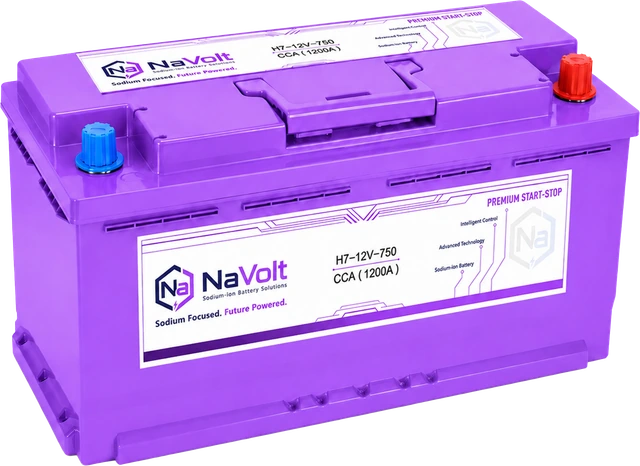
| H7-12V-750 | 60 Ah ±5% | 1,200 A | 315 × 175 × 190 mm | High-load passenger and premium platform review |
| H8-12V-840 | 70 Ah ±5% | 1,400 A | 354 × 175 × 190 mm | Large-case, high-demand review |
| H9-12V-900 | 80 Ah ±5% | 1,600 A | 410 × 175 × 190 mm | Largest H-series case and cranking class |
This is not a vehicle application guarantee. Increasing CCA cannot fix an incompatible tray, cable, terminal, charge profile or battery-management system.
Winter failures often begin before the first crank
Long parking and parasitic load
Telematics, alarms, keyless-entry systems, cameras and other modules consume energy while the vehicle is parked. Record sleep current and parking duration. A battery that is repeatedly left at low state of charge begins every cold start with less available margin.
Short routes
Multiple starts followed by short trips can leave limited time to restore charge. Urban fleets should record starts per shift, trip duration and alternator behaviour rather than assuming daily driving means daily full charge.
Connection resistance
Cold conditions can expose marginal terminals, ground straps and cable joints. Measure voltage drop during crank at the battery posts and at the starter circuit. Replacing the battery without repairing a poor connection can reproduce the same complaint.
Oil, engine and starter condition
Engine oil viscosity, starter condition and mechanical drag affect cranking demand. Battery comparisons should use the same vehicle condition and cold-soak procedure.
Physical fit remains a winter safety issue
Ice, vibration and repeated service can make a marginal installation worse. Confirm the base hold-down, top clamp, terminal cover and cable strain. The current NaVolt 12 V specifications list an M6 bolt-type terminal interface; it is not automatically interchangeable with standard automotive posts.
Battery Council International group-size guidance is useful for dimensions and terminal location, but the actual vehicle must still be inspected. A group name cannot prove adapter design or cable clearance.
A controlled winter sample plan
Before the cold soak
- Identify sample lot and production revision.
- Apply the agreed charge and rest procedure.
- Inspect connections and measure terminal resistance.
- Record battery state of charge and temperature.
During the start test
- Record ambient, case and terminal temperature.
- Capture current and voltage at a useful sample rate.
- Record crank time, minimum voltage and engine speed.
- Note BMS intervention or diagnostic faults.
After the start
- Capture alternator or DC-DC voltage and current.
- Check low-temperature charge behaviour.
- Run repeated restart and engine-off load events.
- Review recovery voltage and state of charge.
During a field trial
- Log no-starts, slow cranks and roadside calls.
- Separate battery failures from charging and cable faults.
- Compare vehicles with similar routes and parking conditions.
Winter procurement checklist
Send these fields with the RFQ:
| Field | Required detail |
|---|---|
| Vehicle | Make, model, year, engine, market |
| Original battery | Chemistry, model, Ah, CCA and age |
| Installation | Dimensions, polarity, terminal, hold-down, photographs |
| Climate | Minimum ambient and measured battery temperature if available |
| Duty | Starts/day, trip length, parking duration, engine-off load |
| Charging | Voltage range, smart alternator, battery sensor, registration |
| Validation | Standard, sample count, cold-soak and pass criteria |
| Commercial | Annual volume, failure baseline, service locations |
Frequently asked questions
Is the battery with the highest CCA always best for winter?
No. CCA must meet the engine requirement under a known standard, but the battery must also fit physically, accept the vehicle charge profile and support parking loads. Excess CCA does not solve an incompatible system.
Does a -45°C discharge range prove a -45°C engine start?
No. The range identifies an operating boundary. A cold-start claim needs a defined battery temperature, state of charge, current, time, voltage limit and target engine or test method.
Should a cold battery be charged at the normal rate immediately?
Use the product’s approved temperature and current limits. NaVolt H-series specifications include a reduced-charge note from 0°C to 5°C. The vehicle integration plan should show how charging is controlled after a cold start.
What should a distributor test before winter inventory is scaled?
Test current production samples in representative vehicles, with controlled cold soak, repeated restarts, charging checks and realistic parking loads. Record raw voltage/current data and diagnostic status.
Conclusion
Cold weather car battery selection is a system check: temperature, CCA method, state of charge, charging, fitment and vehicle condition all matter. Define the winter problem and acceptance method before comparing label numbers.
Review NaVolt sodium-ion start-stop batteries or request a winter fitment and sample review.
Sources
- SAE International, J537_202309: Storage Batteries.
- Battery Council International, BCI Group Sizes.
- NaVolt 12 V Sodium-Ion Battery Technical Specifications, current revisions.