

Technical insight
Fleet Starter Battery Procurement Guide: From Trial to Fleet Rollout
A practical guide for fleet procurement managers evaluating sodium-ion starter batteries: duty requirements, model shortlisting, sample validation, pilot a...
A fleet starter battery procurement program should move through five gates: define the duty profile, assemble vehicle and electrical data, shortlist models with engineering review, validate samples in representative vehicles, and approve a controlled rollout. This sequence helps procurement and maintenance teams evaluate sodium-ion starter batteries against documented fleet requirements before requesting a scaled quotation.
The fleet starter battery procurement guide at a glance
This article follows a five-gate workflow: define the fleet duty profile, build an architecture and fitment data pack, shortlist candidate models subject to engineering review, run sample validation linked to a structured test plan, and plan pilot acceptance followed by rollout or RFQ.
Key takeaways
- A successful fleet battery evaluation begins with a clear duty definition: voltage architecture, CCA requirement, physical envelope, charging system specification, and operating temperature range — not with a model number.
- Sodium-ion starter battery specifications must be evaluated against the fleet’s actual vehicle mix, with fitment confirmed at vehicle and application level.
- The recommended procurement path moves through five gates: duty definition → data-pack collection → model shortlisting → sample validation and pilot → rollout and RFQ.
Define the fleet duty profile
Before reviewing any battery specification, compile the fleet’s baseline requirements. The most relevant factors for a starting battery procurement are:
Voltage architecture. Decide whether the fleet runs 12 V systems, 24 V systems, or both. The electrical architecture determines the compatible battery voltage range. NaVolt’s H and D/B series are built for 12 V applications. The LR-N100-24V is a 24 V product. A 24 V vehicle cannot be served by a single 12 V unit.
CCA and cold-start requirements. Review the OEM-recommended cold-cranking amp (CCA) value for each vehicle model in the fleet. Record the applicable test standard and operating condition so supplier data can be compared on the same basis.
Physical envelope. Measure or source the OEM battery tray dimensions and terminal layout for each fleet vehicle. Battery group sizes (Group 47, 48, 49, 94R, 34, 35, 26) and alternate naming conventions (LN, L, B, D series) help identify the available space envelope.
Charging system specification. Record actual charging voltage, regulator behaviour, battery-management logic, and any battery-registration requirement for each vehicle type. HELLA’s alternator-regulator guidance explains that charging control varies with battery type, temperature, operating state, and intelligent vehicle systems. NaVolt 12 V specification sheets list 15.8 V in the charge-voltage field, so the vehicle’s measured charging profile and the battery’s voltage/current limits must be reviewed together.
Operating temperature range. Record the fleet’s minimum and maximum ambient temperatures. NaVolt 12 V models specify a charge temperature range of −20 to 45 °C and a discharge range of −45 to 60 °C. Actual cold-start performance depends on the specific vehicle, engine, and battery combination.
Build a data pack: architecture and fitment cross-reference
With the duty profile documented, the next step is to cross-reference it against available product specifications and vehicle-fitment records.
Start with product specifications, not vehicle names. Each battery model has a defined nominal voltage, capacity, CCA, maximum dimensions (W × D × H), weight, electrical limits, and terminal interface. These are the controlled specification values. The H-series range illustrates how the specification matrix changes by model:
| Model | Capacity | CCA | Dimensions W×D×H | Weight | Charge voltage | Discharge temp range |
|---|---|---|---|---|---|---|
| H4-12V-400 | 30 Ah ± 5% | 660 A | 207 × 175 × 190 mm | 5.45 ± 0.5 kg | 15.8 V | −45 to 60 °C |
| H5-12V-500 | 40 Ah ± 5% | 850 A | 245 × 175 × 190 mm | 6.52 ± 0.5 kg | 15.8 V | −45 to 60 °C |
| H6-12V-600 | 50 Ah ± 5% | 1000 A | 281 × 175 × 190 mm | 7.85 ± 0.5 kg | 15.8 V | −45 to 60 °C |
| H7-12V-750 | 60 Ah ± 5% | 1200 A | 315 × 175 × 190 mm | 8.90 ± 0.5 kg | 15.8 V | −45 to 60 °C |
| H8-12V-840 | 70 Ah ± 5% | 1400 A | 354 × 175 × 190 mm | 10.15 ± 0.5 kg | 15.8 V | −45 to 60 °C |
| H9-12V-900 | 80 Ah ± 5% | 1600 A | 410 × 175 × 190 mm | 11.40 ± 0.5 kg | 15.8 V | −45 to 60 °C |
The 24 V LR-N100-24V (100 Ah, 2000 A CCA, 524 × 365 × 233 mm L×W×H, 30 ± 1 kg, −40 to 70 °C operating) is a separate product line for 24 V applications.
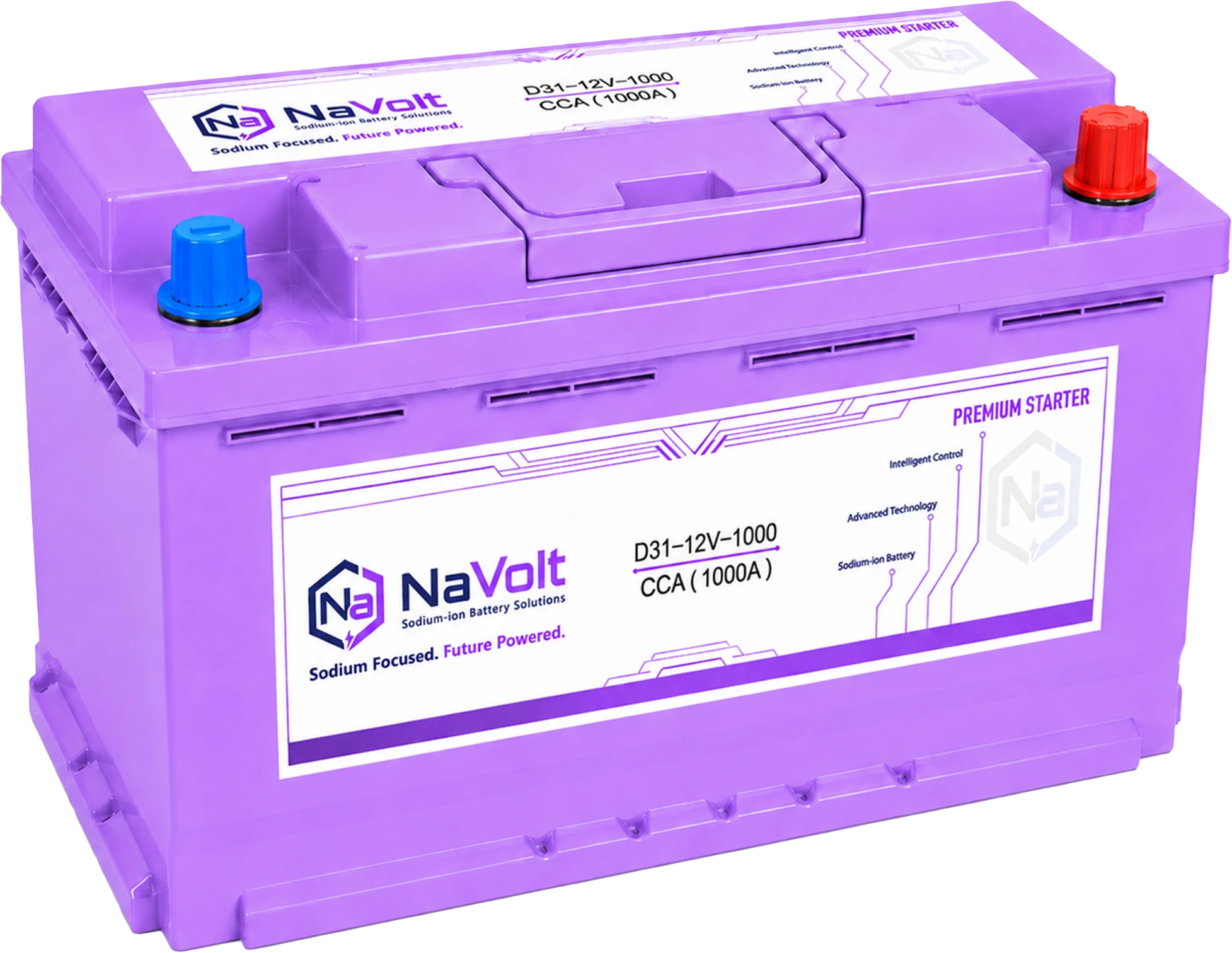
Next, reference vehicle-fitment records for dimensional equivalence. Controlled fitment data maps each NaVolt model to equivalent lead-acid battery group sizes and alternate names. For example, the D31-12V-1000 corresponds to group sizes 95D31(L/R) and 115D31, and its controlled fitment record includes large SUVs, pickup trucks, and commercial vehicle examples validated on real vehicles. Exact year, powertrain, terminal orientation, and installation constraints should still be captured in an RFQ or fitment record.
All other fitment records should be consulted by the fleet buyer during the engineering review stage rather than presumed applicable.
Shortlist candidate models subject to engineering review
Using the duty profile and data pack, a fleet buyer can shortlist candidate models that match each vehicle type. The shortlist is a starting hypothesis — not a final fitment commitment. Each candidate match must be verified through:
- Dimension check: does the battery physically fit the tray, with correct terminal positions and polarity?
- CCA adequacy: how does the battery’s CCA compare with the OEM requirement under the same test standard and operating condition?
- Charging system compatibility: is the vehicle alternator and voltage regulator capable of operating within the battery’s charge voltage and current limits?
- Mounting and restraint: does the battery hold-down system accommodate the battery dimensions and weight?
- Market and model-year variation: the same vehicle model can have different battery requirements across model years, engine options, and regional specifications.
The fleet buyer should share the shortlist with the battery supplier and request a fitment review. NaVolt’s engineering team can review the request against controlled product specifications and the current fitment record.
Sample validation linked to a structured test plan
Before any fleet-wide commitment, request physical samples of the shortlisted models and run them through a structured validation protocol. A dedicated starter battery sample validation and fleet test plan covers the recommended testing methodology, including:
- Dimensional and terminal fitment confirmation on the target vehicle.
- Cold-start performance measurement under the fleet’s actual operating temperature.
- Charging system interaction: voltage regulation, charge acceptance, and alternator load response.
- Start-stop cycle performance (where applicable) under real driving patterns.
- Baseline comparison against the existing battery type under the same conditions.
The validation protocol should define acceptance criteria before testing begins. Documented results from the sample phase enable data-driven pilot planning.
Pilot acceptance and rollout planning
After sample validation confirms that one or more candidate models meet the fleet’s acceptance criteria, the next phase is a controlled pilot:
- Representative scope: include the vehicle types, duty cycles, climates, and charging-system variants that matter to the procurement decision.
- Defined duration: set the observation period or operating-hour target before the pilot, based on the fleet’s seasonal and operational risks.
- Monitoring: track the agreed starting, charging, voltage, diagnostic, and service observations.
- Review gate: define measurable acceptance criteria before installation and assess every pilot vehicle against the same approved record.
A successful pilot allows the fleet buyer to proceed to a structured RFQ for scaled deployment, covering volume, delivery schedule, documentation package, and after-sales support terms.
How this applies to NaVolt
NaVolt offers a range of 12 V and 24 V sodium-ion starter battery specifications that fleet buyers can evaluate through the phased workflow described above. The key controlled specification values — voltage, capacity, CCA, dimensions, weight, electrical limits, and temperature ranges — are published and available for cross-referencing against fleet duty profiles.
Fleet buyers can begin by reviewing the NaVolt starter battery product range for 12 V and 24 V specification options.
NaVolt also maintains a controlled vehicle-fitment reference based on real-vehicle validation recorded in July 2026. This data supports the data-pack phase of the procurement workflow. Exact year, powertrain, terminal configuration, and installation constraints should be confirmed during the engineering review.
For detailed guidance on running the sample phase, refer to the starter battery sample validation and fleet test plan. International buyers can also review the sodium-ion battery export document checklist before submitting a fitment and quotation request.
Confirm these items before rollout
Use these checks to keep the procurement package model-specific and actionable:
- Determine fleet applicability through engineering review and sample validation for the exact vehicle and duty profile.
- Treat the LR-N100-24V as a 24 V specification option (100 Ah, 2000 A CCA) and request an application review for the intended vehicle.
- The vehicle-fitment records are based on real-vehicle validation at the time of testing, but model years, engine options, regional specifications, and terminal configurations vary. Always confirm fitment with the supplier for the exact vehicle under consideration.
- NaVolt battery charge voltage is specified at 15.8 V for 12 V models. Buyers must verify alternator and voltage regulator compatibility with their fleet vehicles.
- Review acceptance criteria for the proposed sodium-ion battery configuration instead of carrying over assumptions from a different battery type.
Frequently asked questions
How should a fleet buyer start evaluating sodium-ion starter batteries?
Begin with a fleet duty profile: document the voltage architecture, CCA requirements, battery dimensions, charging system specifications, and operating temperatures for each vehicle type. Use this profile to cross-reference against published product specifications — not the other way around.
Can a single battery model cover an entire mixed fleet?
Not without engineering review. A fleet with light vans, heavy trucks, diesel and petrol powertrains, and different operating climates will likely require multiple battery models. The shortlisting phase is designed to identify the best match per vehicle category.
Does a sodium-ion battery require changes to the vehicle charging system?
It depends on the vehicle. NaVolt’s 12 V specification sheets list 15.8 V in the charge-voltage field, while vehicle regulators may vary their output by battery type, temperature, and operating state. Buyers should record the actual charging profile and confirm compatibility with the vehicle OEM and NaVolt engineering team.
What documentation is needed for a fleet procurement RFQ?
A procurement package can include the fleet duty profile, shortlisted models, vehicle fitment records, sample validation results, pilot acceptance criteria, delivery schedule, and any applicable export or customs documentation.
How should a fleet define the pilot duration?
There is no universal duration. Set the observation period or operating-hour target before installation so it covers the duty cycles, temperature conditions, vehicle variants, and service risks that drive the purchase decision.
Conclusion
Procuring a new starter battery technology for a fleet is a structured decision process, not a commodity purchase. By following a phased workflow — duty definition, data-pack assembly, model shortlisting with engineering review, sample validation, pilot acceptance, and rollout — fleet buyers can evaluate sodium-ion starter batteries on the basis of documented specifications and real-world testing, not assumptions.
The recommended next step is to build the fleet duty profile and cross-reference it against published product specifications. For RFQ submissions, engineering support, or fitment review requests, contact the NaVolt team.
Sources
- HELLA, “Regulating an alternator: functions, diagnostics and tips for the workshop”. Accessed 2026-07-23.
- NaVolt (Zhejiang Linrun New Energy Technology Co., Ltd.). Approved product specifications. Controlled repository revision 2026-07-17.
- NaVolt Vehicle Fitment Table. Controlled revision 2026-07-19. Real-vehicle validation confirmed by supplier 2026-07-15.
- NaVolt LR-N100-24V approved product sheet. Controlled source, designated 2026-07-15.