

Technical insight
What Is an AGM Battery? Meaning, Benefits, Limitations and Applications
AGM battery meaning explained for buyers: learn how absorbent glass mat construction works, its benefits, limits, applications and replacement checks.
AGM means absorbent glass mat. An AGM battery is a valve-regulated lead-acid battery in which fine glass-fibre separators absorb and retain the electrolyte, so the cell does not contain the same free-flowing liquid found in a conventional flooded battery. This construction supports high current output, repeated cycling and vibration resistance, which is why AGM batteries are widely used in demanding automotive and start-stop applications.
That definition does not make every AGM battery interchangeable. Buyers still need to match voltage, capacity, cold-cranking performance, case, terminals, charging strategy and vehicle requirements.
This article is written for battery distributors, workshops, fleet teams and technical buyers who need a clear working definition before comparing AGM, EFB, flooded and sodium-ion options.
Key takeaways
- AGM is a lead-acid technology, not a separate chemistry from lead-acid.
- Its glass mat holds the electrolyte against the plates instead of leaving free liquid in the cell.
- Valve regulation supports internal gas recombination during normal operation.
- AGM is commonly used where cranking demand, electrical loads and repeated cycling exceed conventional flooded-battery duty.
- It is not automatically the correct choice for every vehicle or charger.
- A replacement decision must follow the vehicle specification and complete fitment checks.
Contents
- What AGM battery meaning tells you
- How an AGM battery works
- AGM battery advantages
- AGM battery limitations
- AGM, EFB and flooded batteries compared
- Common AGM battery applications
- How to identify and replace an AGM battery
- Where sodium-ion enters the evaluation
- Buyer checklist
- FAQ
What AGM battery meaning tells you
Battery Council International defines AGM as absorbent—or absorptive—glass mat and describes the separator as a non-woven material made mainly from glass microfibres. Those fibres absorb and retain the electrolyte, leaving no free electrolyte in the cell to spill. The same glossary defines VRLA as valve-regulated lead-acid.
The full description matters because several common shortcuts are misleading:
- AGM does not mean gel. Gel and AGM are both valve-regulated lead-acid designs, but they immobilize the electrolyte differently.
- AGM does not mean lithium. The electrochemical system remains lead-acid.
- “Sealed” does not mean the case has no pressure-relief mechanism. AGM batteries use valves and should not be opened for routine service.
- “Maintenance-free” generally means the user does not add water; it does not remove the need for inspection, charging control and connection maintenance.
For purchasing records, use the full technology description—VRLA, AGM lead-acid battery—rather than relying on “sealed battery” alone.
How an AGM battery works
An AGM cell still uses lead-based positive and negative active materials and a sulphuric-acid electrolyte. The structural difference is where that electrolyte sits and how gases are managed.
Glass-mat separator
Thin glass-fibre mats sit between the plates. Their pore structure holds the electrolyte close to the active material. This provides a large contact area and keeps the electrolyte from moving freely around the case.
The plates and separators can be packed under compression. The exact design varies by manufacturer, so buyers should not infer plate count, internal resistance or cycle rating from the letters AGM alone.
Valve regulation and gas recombination
During charging, electrochemical reactions can generate oxygen and hydrogen. In a correctly operated VRLA battery, the design encourages much of that oxygen to recombine internally rather than being routinely vented and replaced with water.
The pressure-relief valve remains a safety feature. Incorrect charging, excessive temperature or an internal fault can cause venting. An AGM battery therefore still requires an approved charging method and appropriate installation environment.
Why the construction changes performance
Holding the electrolyte against the plates and maintaining close internal contact can support low-resistance, high-current operation. That is useful for engine cranking and for vehicles that repeatedly move between discharge and recharge states.
Construction alone does not define the full product. CCA, reserve capacity, rated capacity, dimensions, terminal layout and the manufacturer’s charging limits remain model-specific specifications.
AGM battery advantages
The most useful advantages are tied to a defined duty, not to the word “premium.”
| AGM characteristic | Practical buyer value | Qualification |
|---|---|---|
| Electrolyte retained in glass mat | Reduced free-liquid movement and a non-spillable design under specified conditions | A damaged or abused battery still requires safe handling |
| Valve-regulated construction | No routine water addition | The battery still needs inspection and correct charging |
| High-current capability | Strong engine-cranking support when correctly sized | Compare CCA using the same test standard |
| Cycling capability | Better suited than a basic flooded starter battery to repeated start-stop duty | Actual cycle life depends on design and operating conditions |
| Vibration-resistant construction | Useful for demanding vehicle and equipment environments | Confirm the product’s tested vibration requirement |
| Charge acceptance | Supports vehicles with frequent discharge/recharge events | The charging system must match the battery specification |
For a distributor, these characteristics can reduce the risk of placing a basic flooded product into a duty it was not designed to handle. They do not eliminate the need for model selection and application validation.
AGM battery limitations
AGM is not automatically the best option for every buyer. Its disadvantages usually appear when the application, charger or commercial requirement is poorly matched.
Higher purchase cost
AGM construction and manufacturing controls commonly result in a higher purchase price than a conventional flooded starter battery. The relevant comparison is not price alone; it is purchase cost against required duty, expected service interval, workshop time and failure consequences.
Avoid general claims that AGM always lasts a fixed multiple longer. Service life changes with temperature, depth of discharge, state of charge, charging voltage, parasitic load, vibration and the number of restart events.
Charging sensitivity
A valve-regulated battery cannot be treated like an open flooded battery that can be topped up after water loss. Sustained overcharge can dry the internal structure and shorten service life. External chargers need an AGM-compatible programme and settings that match the battery manufacturer’s instructions.
The vehicle charging system also matters. Modern alternator control may respond to temperature, battery sensors, deceleration and load. A single voltage reading at idle is not a complete compatibility test.
Heat and installation conditions
High temperature accelerates battery ageing across lead-acid designs. Battery position, enclosure temperature, ventilation, nearby heat sources and the vehicle manufacturer’s installation specification should all be checked.
AGM’s non-spillable construction does not mean every orientation is approved. Follow the battery and equipment manufacturer’s installation instructions; do not install a valve-regulated battery upside down unless the product is specifically designed and approved for it.
Replacement and registration requirements
Many start-stop vehicles monitor battery current, voltage, temperature or state of charge. A replacement may require battery registration, coding or a service-tool procedure. Fitting the correct physical size without completing the vehicle procedure can leave charging or start-stop functions operating incorrectly.
AGM, EFB and flooded batteries compared
All three technologies below are lead-acid batteries, but they serve different duty levels.
| Feature | Conventional flooded starter battery | EFB | AGM |
|---|---|---|---|
| Electrolyte | Free-flowing liquid | Free-flowing liquid in an enhanced flooded design | Retained in glass mat |
| Construction category | Flooded SLI | Enhanced flooded battery | Valve-regulated lead-acid |
| Typical duty | Conventional engine starting | Entry-level start-stop and increased cycling | Higher-demand start-stop, regenerative charging and high electrical load |
| Water addition | Usually maintenance-free in modern automotive designs, depending on product | Normally maintenance-free | No routine water addition |
| Replacement rule | Follow vehicle specification | Replace according to vehicle-approved technology/specification | Replace according to vehicle-approved technology/specification |
The phrase “normal battery” should be avoided in technical purchasing documents. State whether the reference product is conventional flooded, EFB or AGM.
For a focused decision between the two start-stop lead-acid designs, use the AGM vs EFB battery comparison. The broader start-stop battery guide connects vehicle duty to technology selection.
Common AGM battery applications
AGM is commonly considered when the application combines engine starting with electrical loads or repeated cycling.
Advanced start-stop vehicles
Vehicles with frequent automatic engine stops, regenerative braking and controlled alternator operation can place greater cyclic and charge-acceptance demand on the battery. Official technical guidance from VARTA and GS Yuasa positions AGM for advanced start-stop and high-demand vehicle applications.
That does not mean every start-stop car uses AGM. Many systems specify EFB, while others use a vehicle-specific battery design. The original specification or an approved fitment database should lead the selection.
Vehicles with high onboard electrical demand
Heating, infotainment, control modules, powered accessories and security systems can draw energy when the engine is off or the alternator output is limited. AGM can support these duties when capacity, CCA and reserve requirements are correctly matched.
Commercial, marine and equipment applications
Valve-regulated construction and high-current capability can be useful in commercial vehicles, marine starting, recreational vehicles and off-road equipment. Approval must still address vibration, enclosure, temperature, terminal design and the actual charge source. An automotive AGM label does not prove suitability for every marine or industrial installation.
How to identify and replace an AGM battery
Start with the existing battery label and the vehicle service information. Look for:
AGM,Absorbent Glass MatorVRLAon the label;- the approved battery technology in the vehicle parts catalogue;
- nominal voltage, Ah, CCA and the CCA test standard;
- case or group-size reference;
- positive-terminal position and polarity;
- terminal type, hold-down and vent connection;
- battery-management registration instructions.
Do not identify AGM by shaking the case or by assuming every battery in a boot or passenger compartment is AGM. Visual appearance is not a controlled identification method.
When replacing a vehicle battery, verify the complete installation system. The starter battery fitment guide explains how to check dimensions, terminals, polarity, hold-down and cable clearance.
For workshops, the most reliable process is:
- record the vehicle identification, engine and market version;
- read the original battery label and diagnostic data;
- select the approved technology and electrical specification;
- confirm the physical installation;
- complete registration or coding where required;
- test cranking, charging and start-stop operation;
- document the installed model and service date.
Where sodium-ion enters the evaluation
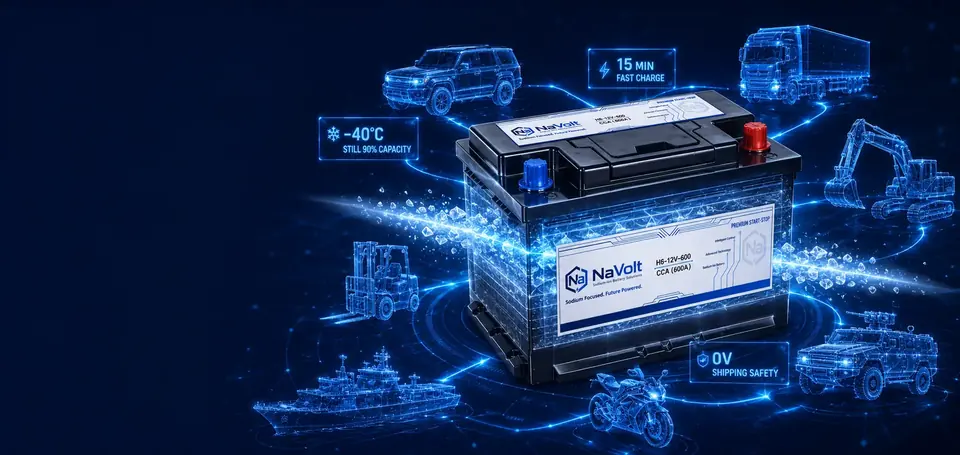
Sodium-ion is a separate battery chemistry, not a subtype of AGM. It can be considered when a distributor, fleet or OEM is evaluating high-rate cranking, low-temperature operation, frequent starts or a lead-acid alternative.
The comparison must be made at system level. A sodium-ion battery with sufficient CCA and similar dimensions is not automatically a direct AGM replacement. The evaluation also needs:
- nominal and operating voltage range;
- current production specification;
- charging profile and current limits;
- capacity and engine-off load requirement;
- case, hold-down and service clearance;
- terminal interface, polarity and cable design;
- battery sensor, registration and coding behavior;
- start-stop and sleep/wake validation;
- transport, documentation and warranty programme requirements.
NaVolt’s sodium-ion starter battery comparison with AGM and EFB explains the technology and channel opportunity. Product selection should follow only after the original battery duty and vehicle requirements are documented.
AGM battery buyer checklist
Before requesting a quote or approving a replacement range, collect:
| Information | Why it matters |
|---|---|
| Vehicle/equipment and market | Controls specification and fitment variants |
| Original battery technology | Prevents unintended AGM/EFB/flooded substitution |
| Voltage, Ah and CCA standard | Defines the electrical baseline |
| Case and terminal layout | Confirms physical installation |
| Start-stop and regenerative features | Defines cyclic and charging duty |
| Battery sensor/coding requirement | Controls replacement procedure |
| Minimum and maximum temperature | Supports application review |
| Daily starts and engine-off loads | Provides the real duty profile |
| Failure and service history | Identifies undercharge, heat or load problems |
| Annual volume and destination | Supports B2B supply and documentation planning |
This information produces a better comparison than asking whether AGM is “better” without describing the vehicle or duty.
FAQ
What does AGM battery mean?
AGM means absorbent glass mat. It is a valve-regulated lead-acid battery design in which glass-fibre separators absorb and retain the electrolyte.
Is an AGM battery the same as a gel battery?
No. Both are VRLA lead-acid types, but AGM uses a glass mat to retain the electrolyte while a gel battery uses a gelled electrolyte. Their charging and application characteristics should not be assumed identical.
What is the main advantage of an AGM battery?
For automotive buyers, the main advantage is its ability to combine high-current starting with stronger cycling and charge acceptance than a basic flooded starter battery, subject to the product specification.
What is the downside of an AGM battery?
AGM usually costs more than a conventional flooded battery and depends on correct charging. Overcharge, excessive heat, chronic undercharge and a mismatched vehicle application can shorten its life.
Does an AGM battery need a special charger?
Use a charger with settings approved for the specific AGM battery. Do not assume every lead-acid charger applies the correct voltage, current control or maintenance mode.
Can an AGM battery be replaced with EFB?
Do not downgrade an AGM application to EFB unless the vehicle or equipment manufacturer explicitly approves it. Technology, electrical specification, charging and registration requirements all need to match.
Can a sodium-ion battery replace an AGM battery?
It may be evaluated as a replacement candidate, but only through a controlled assessment of voltage, CCA, capacity, charging, dimensions, terminals, sensors, coding and vehicle operation. A similar case size is not approval.
Conclusion
AGM battery meaning is straightforward: absorbent glass mat describes a valve-regulated lead-acid design that retains the electrolyte in glass-fibre separators. The practical selection is more demanding. AGM is valuable for high-current and repeated-cycling duties, but its charging, fitment and vehicle-system requirements must be matched to the application.
For a B2B comparison, first document the original battery specification, vehicle or equipment details, charging information and annual demand. Then review NaVolt sodium-ion start-stop battery solutions against that requirement.
Sources
- Battery Council International, Acronyms and Glossary of Common Battery Terms, BCIS-101.
- East Penn Manufacturing, Valve-Regulated Lead-Acid: Gel and Absorbed Glass Mat Batteries — Technical Manual.
- VARTA Automotive, AGM battery technology and use cases.
- GS Yuasa, Advanced battery technologies for modern vehicles.