

Technical insight
Sodium-Ion Starter Battery vs AGM/EFB: One-Page Guide
Compare sodium-ion starter batteries with AGM and EFB on CCA, cycle duty, weight, temperature, fitment and charging before a B2B replacement program begins.
A sodium-ion starter battery can be a credible alternative to an AGM or EFB lead-acid battery when it matches the vehicle’s voltage, cranking requirement, case size, terminal layout, charge strategy and start-stop duty. It is not a universal drop-in replacement. For battery distributors, auto-parts suppliers and fleets, the opportunity is to build validated replacement programs around specific vehicles and operating problems—not to promise that one chemistry fits every car.
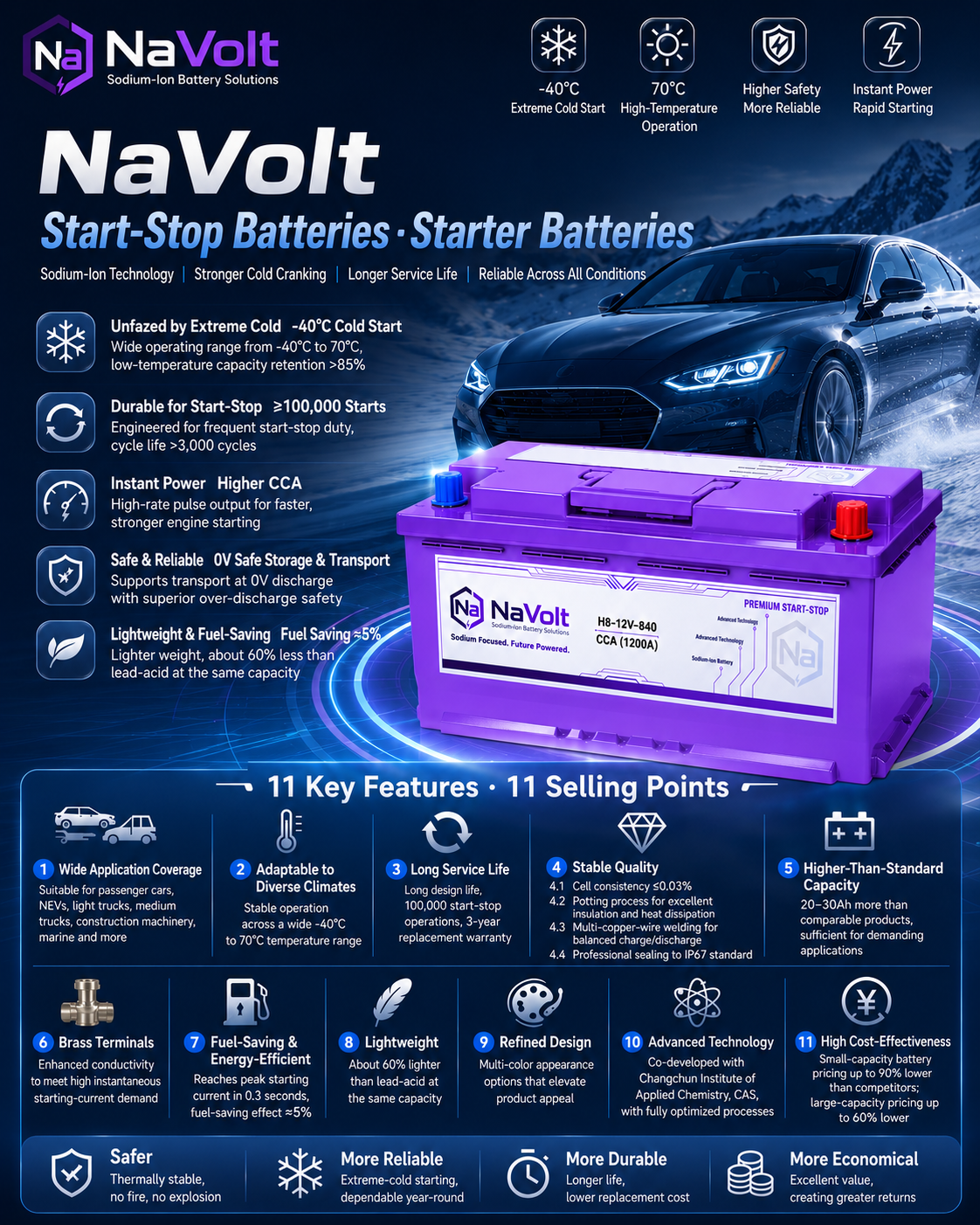
This guide explains the accompanying NaVolt infographic, compares the three battery types, and gives buyers a practical route from product interest to sample validation.
Key takeaways
- EFB is an enhanced flooded lead-acid design commonly used for basic start-stop duty; AGM binds the electrolyte in glass mat and is commonly used for higher electrical demand and regenerative-braking systems.
- NaVolt positions its sodium-ion start-stop platform around high-rate pulse output, frequent starts, low-temperature operation, lower mass and controlled PACK engineering.
- The latest H5-12V-500 specification is
12 V,40 Ah ±5%,850 A CCA,245 × 175 × 190 mmand6.52 ±0.5 kg. - A replacement program must check the charge profile, battery sensor/registration process, BMS behavior, dimensions, hold-down and terminal position.
- Platform-level start-stop and cycle claims require their applicable model and test method before they can support a service-life or warranty comparison.
Contents
- What the infographic tells buyers
- Sodium-ion vs AGM vs EFB
- Where sodium-ion creates a channel opportunity
- What must be validated before replacement
- How to start a distributor or fleet trial
- Frequently asked questions
What the infographic tells buyers
The NaVolt infographic groups the sodium-ion starter-battery proposition into four practical areas: cranking output, climate range, repeated start-stop duty and product engineering. It highlights high-rate pulse discharge for rapid starting, cold-weather positioning, cycle-life positioning, 0 V storage support in configured systems, lower-weight positioning, terminal conductivity, potting, multi-wire welding and sealing.
Those points are useful for commercial screening, but they are not all the same evidence class. Model-specific values such as voltage, capacity, CCA, dimensions, weight and charge/discharge limits come from the current approved technical specifications. Platform and marketing claims still need a defined model, baseline and test method before they can support a quantified product comparison.
> Image data note: The infographic contains an older H8 label of 1200 A. The final approved H8 specification is 1400 A CCA; product selection and quotations must use the approved specification rather than the value printed in the image.
Sodium-ion vs AGM vs EFB
AGM and EFB are both lead-acid technologies developed for more demanding vehicle duty than a conventional flooded starter battery. VARTA describes EFB as an enhanced flooded design for moderate electrical demand and basic start-stop systems, while AGM uses electrolyte absorbed in glass mat and is positioned for frequent regeneration, higher electrical load and more intensive start-stop use. These descriptions are useful benchmarks, not permission to change chemistry without vehicle validation.
The start-stop battery guide explains the vehicle duty, while the AGM vs EFB battery comparison keeps the two lead-acid technologies distinct.
| Decision area | EFB lead-acid | AGM lead-acid | NaVolt sodium-ion start-stop platform |
|---|---|---|---|
| Typical role | Basic start-stop and moderate electrical demand | Advanced start-stop, regenerative braking and higher electrical demand | Validated start-stop and starter replacement projects |
| Electrolyte/system | Liquid electrolyte with enhanced plate support | Electrolyte bound in glass mat | Sodium-ion cells with PACK and BMS design |
| Cranking discussion | Match rated CCA and vehicle requirement | Match rated CCA and vehicle requirement | Match model CCA, pulse behavior and vehicle requirement |
| Cycling | Higher than conventional flooded batteries, product dependent | Designed for demanding repeated cycling, product dependent | Assess the applicable model and test method before making a lifecycle comparison |
| Temperature | Product-specific | Product-specific | Current 12 V specifications separate -20°C to 45°C charging from discharge down to -45°C for most models |
| Weight | Conventional lead-acid reference | Conventional lead-acid reference | Lower-weight positioning; compare actual products with the same duty and test basis |
| Vehicle integration | Battery type and registration may matter | Battery type, sensor logic and registration often matter | Charge voltage, BMS logic, battery registration and fault behavior must be validated |
| Replacement decision | Use approved application data | Use approved application data | Use model specification plus real-vehicle sample validation |
The official VARTA material also notes that start-stop batteries operate through repeated changes in state of charge while continuing to supply onboard electronics when the engine is off. That is why a sodium-ion proposal must be evaluated as part of the vehicle energy system, not only as a box with a higher CCA number.
A current NaVolt product example
The current H5-12V-500 is a representative H Series example for reviewing electrical and physical requirements together.
| H5-12V-500 field | Latest value |
|---|---|
| Nominal voltage | 12 V |
| Rated capacity | 40 Ah ±5% |
| CCA | 850 A |
| Maximum dimensions | 245 × 175 × 190 mm, W×D×H |
| Weight | 6.52 ±0.5 kg |
| Maximum continuous discharge | ≤40 A |
| Charge voltage | 15.8 V |
| Maximum continuous charge | ≤20 A |
| Charge temperature | -20°C to 45°C |
| Discharge temperature | -45°C to 60°C |
| Interface | Positive/negative terminals, M6 bolt type |
The current controlled fitment table records H5 as a 247 × 175 × 191 mm case reference with 850 A at 25°C, a 650–850 A cold-start CCA range and LN2, L2, T5 and Group 47 cross-references. Its example applications include Volkswagen Golf, Sagitar/Jetta, Passat and Lavida; Audi A3/Q3; BMW 3 Series; and Ford Focus. These fields support candidate selection, but the buyer should still validate the current production revision before a fleet rollout.
The starter battery size and terminal fitment guide explains why the product specification and fitment cross-reference must remain separate records.
Where sodium-ion creates a channel opportunity
Battery distributors and agents
The strongest opportunity is a technically controlled upgrade program for customers who already report frequent winter failures, high start frequency, service downtime or weight sensitivity. A distributor can start with a small number of vehicle classes, stock samples instead of broad inventory, and build its own fitment evidence before committing to volume.
Auto-parts suppliers and repair networks
Auto-parts suppliers can add value by collecting the information an online listing often misses: original battery code, tray size, hold-down, terminal orientation, battery sensor, alternator voltage and registration procedure. This turns a chemistry comparison into a professional replacement service.
Fleet operators
Fleets can evaluate total operating cost through cold-start incidents, replacement frequency, service labor, roadside downtime and warranty claims. Unit price alone does not show whether a battery program is commercially successful.
What must be validated before replacement
1. Electrical-system voltage
Confirm whether the battery is a 12 V starter/auxiliary unit or part of a different electrical architecture. A 12 V H-series battery must not be described as a direct 48 V system battery.
2. CCA and acceptance standard
SAE J537 provides testing procedures for automotive 12 V storage batteries and can be scaled for other nominal voltages. An RFQ should state the required standard, conditioning temperature, voltage limit and acceptance result so that two CCA values are genuinely comparable.
3. Charge profile and vehicle energy management
Record alternator voltage, smart-charging behavior, regenerative-braking logic, battery sensor and registration/coding requirement. The sodium-ion BMS must behave correctly across normal charging, engine restart, sleep, low state of charge and fault conditions.
4. Physical fit and terminals
Battery Council International explains that group size covers dimensions, terminal arrangement and other fitment features. Measure the actual tray, height clearance, hold-down, polarity, post type and cable reach rather than relying on capacity alone.
5. Climate and duty cycle
Separate charging temperature from discharging temperature. A cold-start headline does not automatically prove that charging is permitted at the same low temperature or current.
6. Documentation and warranty
Specify the destination market, transport route, required documents and warranty process. Do not infer warranty terms from an infographic; use the written terms confirmed for the applicable model and market.
How to start a distributor or fleet trial
- Select two or three vehicle classes with a measurable problem, such as winter no-start events or unusually frequent replacement.
- Record the original AGM/EFB model, size, terminal layout, CCA, charge voltage and battery-registration requirement.
- Ask NaVolt to propose a model and provide the current specification revision.
- Inspect the sample physically before installation.
- Run controlled vehicle validation across start-stop operation, cold start, parasitic load, charging, sleep/wake behavior and fault handling.
- Track results by vehicle, route, temperature, starts and service events.
- Approve inventory only after technical, warranty and commercial criteria are met.
RFQ checklist: vehicle make/model/year, engine, original battery code, dimensions, polarity, terminal type, required CCA standard, charging voltage, annual demand, target market and documentation requirements.
Frequently asked questions
Can a sodium-ion starter battery replace any AGM battery?
No. It can be a replacement candidate only when voltage, CCA, charge behavior, physical dimensions, terminal layout, vehicle energy management and local requirements are compatible. A sample should be validated in the exact vehicle configuration before volume installation.
Is sodium-ion always better than EFB?
No single chemistry is always better. EFB is established for basic start-stop applications, while sodium-ion may offer advantages for specific cold-start, cycling, pulse-power or weight objectives. The better choice is the one that meets the vehicle requirement with documented validation and acceptable lifecycle cost.
What is the difference between AGM and EFB batteries?
EFB is an enhanced flooded lead-acid battery with liquid electrolyte and improved plate support. AGM binds the electrolyte in absorbent glass mat and is commonly used for higher electrical demand, regenerative braking and more intensive start-stop duty.
Which NaVolt model should a distributor test first?
That depends on the local vehicle population. H5-12V-500 is a practical mainstream review candidate at 40 Ah ±5%, 850 A CCA and 245 × 175 × 190 mm, but the correct first model should be selected from actual customer fitment and failure data.
Are the H8 and H9 CCA values final?
Yes. The final approved values are 1400 A CCA for H8 and 1600 A CCA for H9. Both final specifications list a 15.8 V charge voltage. These product fields supersede older values shown in marketing artwork or fitment-reference tables.
Conclusion
The practical answer to “sodium-ion starter battery vs AGM/EFB” is not a chemistry slogan. Sodium-ion creates a new opportunity for battery agents, auto-parts suppliers and fleets when a specific product solves a measurable operating problem and passes vehicle-level validation. Start with the electrical system, CCA method, case and terminals, then confirm charging, BMS behavior, documentation and warranty before scaling.
For an application-specific decision, use the AGM start-stop battery replacement guide before reviewing the NaVolt sodium-ion start-stop battery range. The primary next step is to send vehicle and battery specifications for a technical assessment.
Sources
- SAE International, J537_202309: Storage Batteries.
- Battery Council International, Acronyms and Glossary of Common Battery Terms.
- VARTA Automotive, Lead-acid, AGM and EFB battery technologies.
- GS Yuasa, Start-stop and modern vehicle battery replacement.
- Battery Council International, BCI Group Sizes.
- NaVolt 12 V Sodium-Ion Battery Technical Specifications, current approved revisions.
- NaVolt Vehicle Fitment Table, controlled revision dated July 19, 2026.