

Technical insight
When Should an AGM Start-Stop Battery Be Replaced With Sodium-Ion?
Assess sodium-ion as an AGM start-stop battery replacement. Compare case fit, terminals, CCA, charging, temperature and vehicle validation requirements.
An AGM start-stop battery should not be replaced simply because another chemistry has a higher CCA figure or a lower listed weight. The change makes sense when it addresses a defined operating problem—and when the candidate battery passes the same physical, electrical and vehicle-level checks expected of any responsible replacement programme.
For distributors and fleets, the useful question is not “Is sodium-ion better than AGM?” It is “Can this sodium-ion model improve this application without creating a fitment, charging or warranty problem?”
The broader start-stop battery guide explains the operating duty. This page focuses on the narrower decision to evaluate sodium-ion in an AGM replacement programme.
When a sodium-ion alternative is worth evaluating
AGM and EFB remain established choices for start-stop vehicles. The AGM vs EFB battery comparison explains their different construction and duty positions. A chemistry change deserves investigation when buyers can point to a measurable problem such as:
- repeated no-start or weak-restart incidents in cold weather;
- high battery replacement frequency in taxis, delivery vehicles or other high-cycle fleets;
- vehicle downtime and roadside callouts that cost more than the battery itself;
- a need for greater cranking margin in a defined case size;
- weight reduction that has a genuine vehicle or handling benefit;
- a distributor requirement for a differentiated, technically supportable product line.
If the existing AGM or EFB battery already performs reliably and economically, replacement may offer little practical value. A sound evaluation starts with service records, climate, duty cycle and the original battery specification—not with chemistry alone.
Start with the installation interface
A battery can resemble an LN, L, T or BCI group-size product and still fail to install correctly. Measure the actual vehicle and record:
- maximum case dimensions and the dimension order used;
- base hold-down or top-clamp geometry;
- positive-terminal position and polarity;
- terminal type, cable-lug size and cable reach;
- clearance above the terminals and beneath the bonnet, seat or enclosure;
- any battery sensor, vent connection, insulation cover or mounting feature.
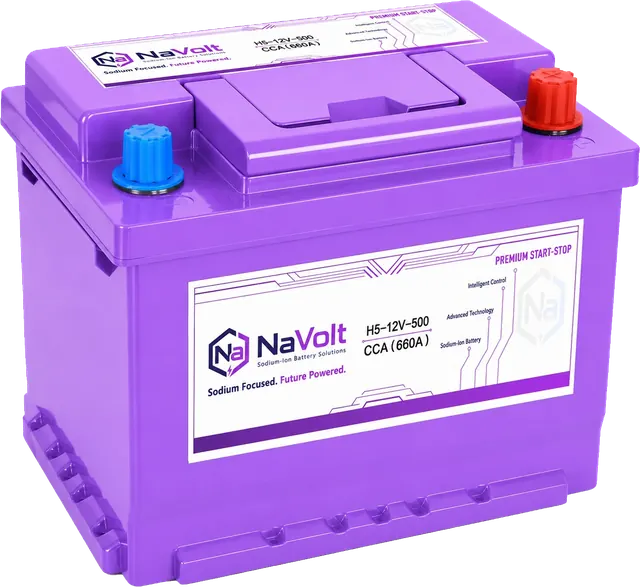
NaVolt’s current 12 V specifications list an M6 bolt-type terminal interface. This is not automatically interchangeable with a standard SAE, DIN or JIS automotive post. A validated cable lug, adapter or vehicle-specific connection may be required. Contact area, tightening torque, current capacity and insulation all need to be approved before installation.
Case-class references are therefore screening tools, not fitment guarantees. NaVolt’s current controlled vehicle-fitment table records case-reference dimensions, 25°C CCA, cold-start CCA ranges, cross-reference names and example vehicle applications. It can help identify candidates, but final approval must still use the current production sample and the exact vehicle year, engine, market and installation configuration.
Use the starter battery size and terminal fitment guide to record the case, hold-down, terminal system, polarity and cable clearance before a sample is shipped.
Compare the electrical requirement, not the model suffix
Cold Cranking Amps (CCA) is useful only when the test method and conditions are understood. Values produced under different standards or preconditioning procedures should not be treated as directly equivalent.
The current approved NaVolt H Series data is:
| Model | Capacity | Current CCA | Maximum dimensions (W × D × H) | Listed weight | Status note |
|---|---|---|---|---|---|
| H4-12V-400 | 30 Ah ±5% | 660 A | 207 × 175 × 190 mm | 5.45 ±0.5 kg | Current specification |
| H5-12V-500 | 40 Ah ±5% | 850 A | 245 × 175 × 190 mm | 6.52 ±0.5 kg | Current specification |
| H6-12V-600 | 50 Ah ±5% | 1,000 A | 281 × 175 × 190 mm | 7.85 ±0.5 kg | Current specification |
| H7-12V-750 | 60 Ah ±5% | 1,200 A | 315 × 175 × 190 mm | 8.90 ±0.5 kg | Current specification |
| H8-12V-840 | 70 Ah ±5% | 1,400 A | 354 × 175 × 190 mm | 10.15 ±0.5 kg | Final specification |
| H9-12V-900 | 80 Ah ±5% | 1,600 A | 410 × 175 × 190 mm | 11.40 ±0.5 kg | Final specification |
The number at the end of each model name is not the current CCA rating. Buyers should use the dedicated CCA field shown in the final specification.
A higher CCA value can provide additional cranking margin, but it does not prove that a battery is suitable for the vehicle. Capacity, continuous-current limits, voltage response, terminal resistance, temperature and the vehicle’s battery-management behaviour remain part of the decision.
Charging compatibility needs an engineering review
Physical fit is only half the job. Start-stop vehicles may use smart alternators, battery sensors, regenerative-braking charge states, battery registration or software assumptions developed around AGM or EFB behaviour.
The current NaVolt 12 V specifications confirm a 15.8 V charge voltage. Vehicle approval should verify that the actual charging system is compatible with the battery specification; the value is a battery charging parameter, not a claim that every vehicle alternator continuously outputs 15.8 V. Before approving a replacement, measure or obtain:
- normal and maximum charging voltage;
- charge behaviour at idle, during deceleration and after restart;
- battery-sensor and energy-management logic;
- registration or coding requirements;
- sleep current and long-parking behaviour;
- low-temperature charge control;
- diagnostic trouble codes and fault-recovery behaviour.
A workshop trial that checks only whether the engine starts can miss charging or sleep-state problems that appear days later.
Keep temperature claims tied to the model
Charging temperature, discharge temperature and cold-start performance answer different questions. They should not be combined into one broad “operating temperature” claim.
Current H-series specifications list charging from -20°C to 45°C and discharging from -45°C to 60°C. Cold-start performance requires its own temperature, state-of-charge, load, duration and minimum-voltage criteria. A range printed for another model—or a platform-level marketing statement—must not replace the H-series specification.
Platform-level start-stop and cycle claims should not be converted into fleet-life or warranty projections without the applicable model, test method, depth of discharge, temperature and end-of-life criterion.
AGM, EFB and sodium-ion serve different programme needs
| Decision factor | AGM/EFB replacement | Sodium-ion candidate |
|---|---|---|
| Market familiarity | Mature catalogue and workshop knowledge | Requires product education and controlled introduction |
| Vehicle-system alignment | Often follows the original vehicle specification | Charging and monitoring behaviour must be reviewed |
| Cold-weather case | Established performance with age and state-of-charge effects | Worth testing where cold restart is a documented problem |
| Weight | Typically heavier for a comparable case and duty | Lower listed product weight may benefit specific applications |
| Fitment data | Broad aftermarket cross-reference coverage | Internal cross-references must be confirmed on the exact vehicle |
| Service and warranty | Familiar replacement process | Claims, installer instructions and validation records must be built deliberately |
This is why a phased introduction is usually more defensible than a catalogue-wide substitution. Start with a small number of vehicle classes where the pain is documented and the installation can be controlled.
For the broader chemistry decision, the sodium-ion starter battery vs AGM/EFB guide compares the technologies without replacing this page’s validation workflow.
A practical validation sequence
1. Define the problem
Use service data to state what must improve: winter no-start rate, replacement interval, downtime, cranking voltage, weight or another measurable result.
2. Shortlist the model
Match nominal voltage, required CCA, capacity and continuous-current limits. Then check the current specification revision rather than relying on the model name.
3. Inspect the vehicle
Record the tray, hold-down, terminals, polarity, cable route, sensor and enclosure. Photographs with dimensions are more useful than a group-size label alone.
4. Review charging and controls
Compare the vehicle voltage profile and monitoring logic with the battery’s approved charge limits and BMS behaviour.
5. Run bench and vehicle tests
Use a written method for CCA or pulse testing, followed by cold soak, repeated start-stop operation, hot restart, accessory load, sleep/wake and diagnostic checks in the target vehicle.
6. Document approval
Tie the result to the production revision, vehicle year, engine, market, terminal solution and software configuration. That record is what turns a successful sample into a supportable product programme.
Information to include in an RFQ
Send enough detail for engineering to reject a poor match before a sample is shipped:
- vehicle make, model, year, engine and destination market;
- current battery chemistry, model, voltage, capacity and CCA;
- battery dimensions, terminal type, polarity and hold-down;
- photos of the label, tray, cables and installed battery;
- minimum winter temperature and normal duty cycle;
- starts per day and engine-off electrical loads;
- charging-voltage range, battery sensor and coding requirements;
- annual demand, sample plan and required technical documents.
For fleet work, add replacement history, no-start records and the cost of downtime. Those figures make the commercial comparison far more useful than purchase price alone.
Frequently asked questions
Can sodium-ion replace every AGM start-stop battery?
No. The candidate must match the physical installation, terminal interface, charging system, CCA requirement, temperature and start-stop duty. Some vehicles designed around AGM behaviour may not be suitable without further engineering work.
Is H5 a direct replacement for every LN2, L2, T5 or Group 47 battery?
No. The H5 product specification lists 245 × 175 × 190 mm, 40 Ah ±5% and 850 A CCA. The current fitment table separately records a 247 × 175 × 191 mm case reference, 850 A at 25°C, a 650–850 A cold-start CCA range and LN2/L2/T5/Group 47 references, with Volkswagen Golf, Sagitar/Jetta, Passat and Lavida; Audi A3/Q3; BMW 3 Series; and Ford Focus as example applications. These reference fields do not override the product specification or guarantee every vehicle variant. The M6 terminal interface, hold-down, polarity, cable connection and vehicle electronics still require confirmation.
Does higher CCA guarantee a better replacement?
No. Higher CCA may add cranking margin, but it cannot correct the wrong case, incompatible terminals, an unsuitable charging profile or poor vehicle-system integration. Compare CCA under the same standard and conditioning method.
Should a distributor compare purchase price or lifecycle cost?
Both, but lifecycle cost is the stronger basis for fleet and warranty decisions. Include replacement frequency, roadside callouts, labour, downtime, returns and installer training as well as the battery price.
What should be tested before a larger order?
At minimum, verify the current sample on the target vehicle for physical fit, connection security, crank performance, charging behaviour, start-stop function, sleep/wake operation and diagnostic faults. Cold-climate programmes should also include a controlled cold-soak test.
Conclusion
Sodium-ion is a credible AGM or EFB replacement candidate when it solves a documented problem and survives a disciplined approval process. The strongest programmes begin with a narrow vehicle set, current product specifications and measurable acceptance criteria. They do not begin with a universal replacement claim.
Review NaVolt sodium-ion start-stop batteries or send your vehicle and existing battery data for a fitment review.
Sources
- SAE International, J537_202309: Storage Batteries.
- NaVolt 12 V Sodium-Ion Battery Technical Specifications, current revisions.
- NaVolt Vehicle Fitment Table, controlled revision dated July 19, 2026.
- NaVolt start-stop product material, current controlled version.