
Technical insight
D31-12V-1000 Sodium-Ion Starter Battery for SUVs and Pickups
Evaluate the D31-12V-1000 sodium-ion starter battery for SUV, pickup and commercial applications using current specs, fitment and vehicle checks.
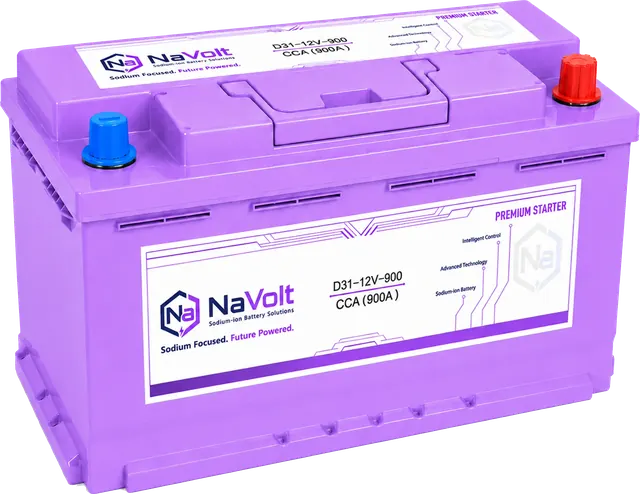
The NaVolt D31-12V-1000 is a 12 V sodium-ion starter battery specified at 50 Ah ±5% and 1,000 A CCA. Its current maximum dimensions are 306 × 173 × 222 mm in W × D × H order, with a listed weight of 7.85 ±0.5 kg.
The D31 case family is relevant to large SUVs, pickups and some light-commercial applications, but vehicle approval must confirm polarity, M6 terminals, tray design, charging and actual cranking demand.
D31 current specification
| Field | D31-12V-1000 value |
|---|---|
| Chemistry | Sodium-ion |
| Nominal voltage | 12 V |
| Capacity | 50 Ah ±5% |
| CCA | 1,000 A |
| Maximum dimensions | 306 × 173 × 222 mm, W × D × H |
| Weight | 7.85 ±0.5 kg |
| Maximum continuous discharge | ≤50 A |
| Discharge cut-off | 6 V |
| Charge voltage | 15.8 V |
| Maximum continuous charge | ≤25 A |
| Internal resistance | ≤4 mΩ |
| Terminal interface | Positive and negative, M6 bolt type |
| Charge temperature | -20°C to 45°C |
| Discharge temperature | -45°C to 60°C |
| Storage temperature | 0°C to 45°C |
The 1,000 A CCA value is separate from the D31-12V-1000 model suffix and from the ≤50 A continuous-discharge limit. Buyers should not merge those fields in catalogues or RFQs.
D31 fitment signals
NaVolt’s current controlled fitment table records D31 with a 306 × 173 × 225 mm case-reference dimension, 1,000 A at 25°C, a 700–850 A cold-start CCA range and 95D31 L/R and 115D31 cross-references. Example applications include Toyota Land Cruiser, Tundra and Sequoia; Nissan Patrol; Isuzu D-Max; and other large SUV, pickup or commercial-vehicle platforms.
The 306 × 173 × 225 mm dimension and 700–850 A cold-start range belong to the fitment table. They do not overwrite the current product specification, which controls the 306 × 173 × 222 mm maximum product dimensions and 1,000 A CCA field.
Why L/R polarity cannot be ignored
D31 catalogue names often include an L or R polarity designation. Record the viewing direction and terminal position with a photograph. Cable length on a large SUV or pickup may leave little room for a reversed or relocated connection.
Before approving a sample, check:
- positive-terminal position from a defined front view;
- negative-terminal position and ground-cable route;
- base hold-down and tray lip;
- cable reach without tension;
- clearance to bonnet, seat or enclosure;
- access for terminal tools and insulating covers.
The current D31 specification uses M6 bolt terminals. That interface requires an approved lug or adapter and must not be described as a standard automotive-post connection without evidence.
Match the battery to the vehicle duty
Large SUVs and pickups do not all impose the same battery load. An urban private vehicle, diesel pickup, field-service truck and vehicle with winches or auxiliary lighting have different start and reserve requirements.
Document:
- engine type and displacement;
- required CCA and test standard;
- starts per day and restart behaviour;
- engine-off accessory load;
- parking duration and parasitic current;
- minimum and maximum temperature;
- alternator or DC-DC charging profile.
Auxiliary equipment should not be assumed to run continuously from the starter battery. Define the electrical architecture and whether a separate house or auxiliary battery is used.
Charging-system review
The D31 specification lists a 15.8 V charge voltage and maximum continuous charge current of 25 A. Vehicle charging may vary with temperature, engine state, battery sensor and regenerative strategy.
Capture voltage and current at:
- key-on and initial crank;
- idle after start;
- elevated engine speed;
- deceleration or smart-charge high state;
- hot restart;
- low-temperature restart;
- sleep and wake transitions.
The goal is to confirm compatibility with the battery’s approved charging requirement, not to force one static vehicle-voltage reading.
D31 sample validation table
| Test area | Minimum evidence | Release concern |
|---|---|---|
| Physical fit | Measured tray, hold-down and clearance | Movement, clamp load or bonnet contact |
| Terminal design | Drawing, torque, insulation, voltage drop | Heat, loose connection or short circuit |
| Cranking | Current, minimum voltage, time, temperature | Insufficient margin or BMS intervention |
| Charging | Voltage/current profile and diagnostics | Over-limit or incomplete recharge |
| Parking | Sleep current and restart after parking | Unexpected discharge |
| Field duty | Route, loads, vibration and climate | Trial not representative of customer use |
When D31 is not the right answer
D31 should not be selected when the vehicle is 24 V, the tray requires a different case, conventional posts are mandatory without an approved adapter, or the continuous auxiliary load exceeds the agreed starting-battery duty. The NaVolt LR-N100 is a separate 24 V product; a single D31 remains a 12 V battery.
For smaller Japanese-style cases, B24, D23 or D26 may be more appropriate candidates. Selection should start with the original battery and tray rather than with the highest available CCA.
RFQ checklist for D31 projects
- Vehicle make, model, year, engine and destination market
- Original battery label and photographs
- 95D31/115D31 or other case reference
- Tray and overall clearance measurements
- Required polarity and terminal connection
- CCA standard and required rating
- Charge-voltage profile and battery sensor
- Auxiliary electrical loads
- Climate, route and parking duration
- Sample quantity and annual forecast
Frequently asked questions
Is D31-12V-1000 a 1,000 A CCA battery?
Yes. The current approved product specification lists 1,000 A CCA. The model code should still be stored separately from the CCA field.
Can D31 replace every 95D31 or 115D31 battery?
No. Those references support candidate matching, but dimensions, L/R polarity, M6 terminal design, hold-down, vehicle charging and engine requirements must be confirmed.
Is D31 suitable for a 24 V truck?
A single D31 is a 12 V product. Do not present it as a direct 24 V replacement. A series design or the 24 V LR-N100 platform requires separate engineering approval.
Does 1,000 A CCA support continuous auxiliary loads?
No. CCA is a short-duration starting rating. The current specification lists ≤50 A maximum continuous discharge, and the actual system duty needs a separate energy and BMS review.
Conclusion
The D31-12V-1000 sodium-ion starter battery provides a defined 50 Ah and 1,000 A CCA option for D31-class vehicle projects. Successful use depends on polarity, terminal engineering, charging-system compatibility and a trial that represents the actual SUV, pickup or commercial duty.
Review the D31-12V-1000 product page or send a D31 vehicle record for technical matching.
Sources
- Battery Council International, BCI Group Sizes.
- SAE International, J537_202309: Storage Batteries.
- NaVolt D31 Technical Specification, current approved revision.
- NaVolt Vehicle Fitment Table, controlled revision dated July 19, 2026.