

Technical insight
H5-12V-500 Sodium-Ion Battery: Fitment and Buyer Checks
Review H5-12V-500 sodium-ion battery specs, LN2/L2/Group 47 fitment signals, M6 terminals, charging and vehicle checks before ordering evaluation samples.
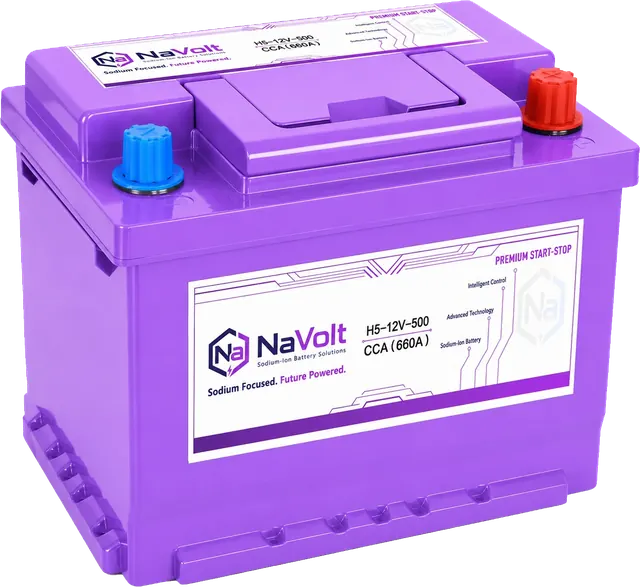
The NaVolt H5-12V-500 is a 12 V sodium-ion start-stop battery specified at 40 Ah ±5% and 850 A CCA. Its current maximum dimensions are 245 × 175 × 190 mm in W × D × H order. Internal fitment references associate the case class with LN2, L2, T5 and Group 47 candidate applications.
Those references make H5 relevant to mainstream passenger-car replacement programmes, but they do not make it a universal drop-in battery. The M6 terminals, hold-down, polarity, charging system and exact vehicle configuration must be approved.
H5 current specification
| Field | H5-12V-500 value |
|---|---|
| Chemistry | Sodium-ion |
| Nominal voltage | 12 V |
| Capacity | 40 Ah ±5% |
| CCA | 850 A |
| Maximum dimensions | 245 × 175 × 190 mm, W × D × H |
| Weight | 6.52 ±0.5 kg |
| Maximum continuous discharge | ≤40 A |
| Discharge cut-off | 6 V |
| Charge voltage | 15.8 V |
| Maximum continuous charge | ≤20 A |
| Internal resistance | ≤4 mΩ |
| Terminal interface | Positive and negative, M6 bolt type |
| Charge temperature | -20°C to 45°C |
| Discharge temperature | -45°C to 60°C |
| Storage temperature | 0°C to 45°C |
CCA and maximum continuous discharge describe different operating conditions. The 850 A rating does not authorize 850 A continuous discharge, while the 40 A continuous limit does not describe the short crank pulse.
Where the H5 case class appears
NaVolt’s current controlled fitment table records H5 with a 247 × 175 × 191 mm case-reference dimension, 850 A at 25°C, a 650–850 A cold-start CCA range and LN2, L2, T5 and Group 47 cross-references. Example applications listed in the table include Volkswagen Golf, Sagitar/Jetta, Passat and Lavida; Audi A3/Q3; BMW 3 Series; and Ford Focus.
These examples help a distributor identify vehicles for sample review. They are not a blanket fitment guarantee across every model year, engine, market or battery-cable design.
Battery Council International explains that group-size systems bring together dimensions, terminal location and related fitment characteristics. The vehicle still has its own electrical requirements.
The first fitment risk is the terminal
The final H5 specification lists an M6 bolt-type interface. Many passenger-car batteries use SAE, DIN or JIS post designs, so an H5 sample cannot be approved from case dimensions alone.
The connection review should include:
- cable-lug or adapter drawing;
- conductor cross-section and current capacity;
- contact surface and plating;
- specified tightening torque;
- positive-terminal insulation;
- cable reach and bend radius;
- tool clearance beneath the bonnet or enclosure;
- voltage drop during crank.
If an adapter is required, it should have a controlled part number and installation instruction. A workshop should not improvise the connection during a customer installation.
Check the tray and hold-down
Measure the original battery and tray in millimetres. Record maximum length, width, case height and overall height including covers or terminals. Check the base flange, clamp position and any enclosure wall.
Place the H5 production sample in the tray before connecting it. Confirm that:
- the base or top hold-down engages correctly;
- the lid and BMS cover are not loaded by the clamp;
- polarity matches the cable layout;
- terminal covers can be installed;
- the battery can be removed without damaging adjacent systems.
Small dimensional differences can affect clamp engagement even when two products share a familiar case-class name.
Charging compatibility is a vehicle decision
The H5 charge voltage is specified at 15.8 V. The vehicle may use a smart alternator, regenerative-braking states, a battery sensor or a registration procedure. Measure the complete charge profile rather than looking for one static alternator value.
Review:
- voltage at idle, during deceleration and after restart;
- maximum and minimum charge current;
- low-temperature charging behaviour;
- battery sensor and state-of-charge estimation;
- coding or registration requirements;
- sleep current and long-parking behaviour;
- diagnostic faults and recovery.
The battery specification and vehicle behaviour must be compatible. Neither one should be inferred from the other.
Why H5 attracts fleet and distributor interest
H5 sits in a high-volume passenger-car case range while providing 850 A CCA from the current sodium-ion specification. This creates a practical pilot opportunity for distributors serving cold climates, start-stop vehicles and high-use fleets.
The commercial case should be based on measurable outcomes:
- restart performance after cold soak;
- roadside-callout rate;
- replacement frequency;
- installation time and adapter reliability;
- charging and diagnostic behaviour;
- return and warranty rate.
Do not promise a specific cost saving before the buyer has a baseline and a controlled trial.
H5 sample validation plan
Desk review
Collect the original battery label, dimensions, CCA, vehicle details and charging information.
Installation review
Approve the case, hold-down, polarity, M6 connection, covers and cable routing.
Electrical review
Record crank current and minimum voltage, charging voltage/current, sleep current and diagnostic state.
Duty-cycle review
Run repeated stop/start events, engine-off accessory loads, hot restart and long parking. Add cold soak where the market requires it.
Release decision
Tie approval to the current H5 production revision and exact vehicle configuration. Record any adapter or coding requirement in the catalogue entry.
RFQ information for H5 matching
| Category | Information to send |
|---|---|
| Vehicle | Make, model, year, engine and destination market |
| Original battery | Brand, model, chemistry, Ah and CCA |
| Physical fit | Dimensions, polarity, terminal and hold-down photographs |
| Electrical system | Charge-voltage range, battery sensor and coding |
| Duty | Starts/day, parking, engine-off loads and climate |
| Programme | Sample quantity, annual forecast, service and warranty plan |
Frequently asked questions
Is H5-12V-500 an 500 A battery?
No. H5-12V-500 is the approved model code; the current specification lists 850 A CCA. Keep the model code and CCA in separate catalogue fields.
Is H5 a direct Group 47 or LN2 replacement?
It is a candidate for those case classes, not a universal direct replacement. Verify dimensions, hold-down, polarity, M6 connection, charging, sensors and the exact vehicle.
Can H5 replace an AGM or EFB battery?
It can enter a controlled replacement assessment when the full installation and electrical requirements are matched. Chemistry, size or CCA alone is not sufficient.
What is the most important sample check?
Terminal and vehicle charging compatibility are the highest early risks. Resolve them before a fleet or workshop trial begins.
Conclusion
The H5-12V-500 sodium-ion battery is a well-defined 40 Ah, 850 A CCA candidate for mainstream passenger-car programmes. Its commercial value depends on disciplined M6 terminal design, vehicle charging review and documented sample validation.
Review the H5-12V-500 product page or request H5 vehicle matching.
Sources
- Battery Council International, BCI Group Sizes.
- SAE International, J537_202309: Storage Batteries.
- NaVolt H5-4S4P Technical Specification, current approved revision.
- NaVolt Vehicle Fitment Table, controlled revision dated July 19, 2026.